Sunday, November 7, 2010

Vegas Musings

Vegas is hilarious to me.  I think it is pretty awesome that people come from all over the world to experience all of the different things Vegas has to offer.  I was in Vegas last weekend visiting friends and doing some due diligence on a few casino stocks I own (hat tip J and Z) and I noticed some items worth sharing:

1.)  Cab drivers are giving stock tips again? I was surprised to be questioned by my cab driver why I owned WYNN (traded on Nasdaq) when the better play, in his expert opinion, was the WYNN Macau stock that trades in Hong Kong (ticker: 1128.hk).  When cab drivers are giving away investment tips I tend to get nervous.

2.)  Vegas is still hurting.  Steve Wynn said things will not get much worse but you can tell they are reaching to squeeze every ounce from the public.  I was annoyed to find out that I could not get Wi-Fi in my room unless I paid the resort fee of $30 a day.  That was not as bad as the $1.50 extra charge for bleu cheese olives in my martini.  Lastly, table service at the club must be down a good amount.  I got far too many cordial texts from the VIP guy at the WYNN asking me when will I arrive at the club.  Back in the bull market, they used to drop your reservation if you did not show by midnight.  Now they text you until 2 a.m. begging for your business.

3.)  People are really serious about risks from the 'Death Ray' at the new Vdara hotel.  If you are not familiar, the sun's reflection off the south face of the hotel is so strong that "if you're at the hotel's swimming pool at the wrong time of day -- it can singe your hair and melt your plastic drink cups and shopping bags."  Check out one artist's rendering of the giant sized "ant and the microscope" catastrophe at the Vdara below.  This is pure genius:


4.)  The slot machine industry is mocking its own customers by putting new ridiculous games on casino floors.  I came across a slot machine at the Palazzo that I had to take a quick snap of.  Below, I compare a traditional slot machine (on the left) to one of the new "win on multiple lines" games (on the right).  Are you kidding me?  It is bad enough that people don't have to use the hand crank anymore but now they get to follow not 1 or 2 more lines....but 100 lines! 


Here's to the people that plug into slot machines until they have to be woken by security...without you gentle folks, the casino's would be forced to charge Angelo Mozilo and the other sunbathers extra, when exposing them to magnified gamma rays like those at the Vdara. 

Tuesday, November 2, 2010

A Monetary Walk of Shame

Photo: PacificCoastNewsOnline.com
Preceding this week’s highly anticipated midterm elections and two-day Federal Reserve meeting, PIMCO'S Bill Gross published his monthly investment outlook containing some shift in sentiment toward the very system that he advocated just over a year ago.  Gross, PIMCO'S longtime Co-chief investment officer, has long been lauded as the “Bond King” and stands at the rarified investment pulpit with the likes of Warren Buffett, Jack Bogle, and Benjamin Graham.  His investment outlooks are considered must-reads for anyone in financial services,  as they provide insight into what the investment elite are pondering.   In this piece entitled “Run, Turkey, Run,” (LINK) Gross predicts that the upcoming Fed meeting: “will likely signify the end of a great 30-year bull market in bonds and the necessity for bond managers and, yes, equity managers to adjust to a new environment.”
Is Gross crafting PIMCO'S own obituary with a statement like this or does this signify PIMCO’s entrance into the equity world as he surrenders to fewer return opportunities in the bond market?  Or is the “Oracle of Orange County” taking the first step in a monetary walk of shame, conceding that policies which made sense before have become runaway fiat freight trains that he jubilantly rode?
While Gross has always appeared to have an anti-big-government bend to his commentaries, he was not afraid to partner with the government and even imitate the Fed in 2009 when the United States was peering into the economic abyss. In his January 2009 outlook he wrote, “PIMCO’s view is simple: shake hands with the government; make them your partner by acknowledging that their checkbook represents the largest and most potent source of buying power in 2009 and beyond...For now, our Ponzi-style economy and its policy remedies encourage bond investors to mimic Uncle Sam and its global compatriots. Buy what they buy, but get there first.” (LINK) At the time, it was perfectly acceptable to run the printing press in support of our great nation as managers were desperately seeking refuge from the crisis of 2008.  (In other words, "it seemed like a good idea at the time but i do remember having a few too many drinks.") 
In his February 2009 outlook, Gross congratulated the Fed and showed optimism towards the unprecedented efforts at a time when markets were particularly fragile.  He applauded the Commercial Paper Funding Facility and the Fed’s purchase program for agency backed mortgages opining that these two programs “have been the major policy successes to date…because they have supported and increased asset prices whose decline has been the major deflationary thrust behind the real economy. Stop asset prices from going down and with a 12-month lag, unemployment will stop going up, and President Obama’s targeted three million new jobs will have a fighting chance of being achieved” (LINK).
Today, Gross feels that the Fed and government which he admittedly partnered with in 2009 have gone too far.  In his most recent note he says, “Check writing in the trillions is not a bondholder’s friend; it is in fact inflationary, and, if truth be told, somewhat of a Ponzi scheme…Now, however, it seems the Fed has taken Charles Ponzi one step further.”  Even though the idea that developed nation’s public debt being a Ponzi scheme is not new, Gross has reached his own proverbial tipping point (in other words Gross has been sleeping with the enemy).
  
So why the sudden change of heart? When did we transform from the collective supporting of asset prices to what he now calls a “Sammy Scheme” (Uncle Sam’s version of a Ponzi scheme that has been orchestrated by politicians and subsequently enabled by the voters that elected them)?  Maybe this is the way it always was and no one wanted to admit it?  Gross is coming to grips with the reality that the Federal Reserve, despite its alleged independence, is a highly politicized tool used not only to support asset prices and provide liquidity, but fuel deficits, and rather large ones at that.  I would not want to wake up and rollover to that realization either. 

Monday, October 25, 2010

Exit the "Knowledge Economy"...Enter the "Creative Economy"

I recently heard Gary Hamel speak at the Ross School of Business (University of Michigan) in Ann Arbor.  I had never heard of Gary before walking into the auditorium, and after listening to him for 45 minutes, I wanted to know everything about him.  This guy is good! (http://www.garyhamel.com/)

I took some interesting notes during his talk.  Gary is an expert corporate strategist who specializes in the topic of management, specifically how to "reinvent" management.  The point that resonated most with me was a slide he posted called "Gary's Hierarchy:"

Essentially, Gary argues that intelligence is pretty much par for the course in today's economy and the real way to differentiate is through creative ability.  You can outsource all of the technical skills we were told would take us deep into the 21st century (programming, engineering, finance, etc.).  He believes that business is more turbulent today and companies are not able to mitigate the turbulence fast enough.  Modern management styles are no longer modern (most taught management styles are from the beginning of the 20th century). Couple this with a faster business cycle and you too may see the need for more agility and creativity from leadership.

Listening to Gary, I immediately took pity on the millions of Americans who are making one of the various paths through higher education their own.  It seems like an all too common solution for the current recession we are in is to go back to school...and universities know this so school is not getting cheaper anytime soon.  Is all of the money spent on tuition to get a certificate and get "smart" worth it when the more applicable skills come from unlocking creative ability?

Tuesday, September 28, 2010

The Neighborhood Watch is Back


Crowded gun show in Michigan this past weekend (courtesy of Chad Hines)

I am starting to wonder what the end game for gun ownership in America looks like.  More frequently we hear "gold" and "guns" uttered in the same breath.  In fact, last year when talking to my accountant about owning gold and silver his first question was: "How many bullets to do own?"  I did not own a gun at that time so my response was "zero." With a smirk his follow up remark was: "Your gold is worth nothing if you can't protect it."  So is there more value in owning the gold or owning the guns?  Some take the conversation a step further by saying that organic seeds (not your round-up ready seed varieties from Monsanto) would be most valuable because if the world blows up, people will need self-sustaining food sources in order to exist past what little they can store in their basements.  Again, this thought brings me back to my accountant's comment: "Your (INSERT ANYTHING HERE) is worth nothing if you can't protect it."

Gun ownership is controversial in its own right and is something I never paid much mind toward.  Why should anyone NEED a gun?  We pay taxes so that our local governments can staff an operational police department armed with enough weapons to protect the community.  Right?  Well, what happens when those local governments run into financial difficulty and can no longer support the boys in blue to the extent they were able to in the past?  We get situations like in Ashtabula County (Ashta-who??) where a judge told citizens to "arm yourselves" (LINK).   Earlier this year in Colorado Springs, the police department was forced to downsize and raise cash by selling off their helicopters (LINK).  I cannot imagine that engenders much of a sense of security in that community.  We are seeing more and more evidence that Americans are taking their safety into their own hands.  Suddenly, the Neighborhood Watch Program is not for the old retiree who likes to ride his or her bike around the block at dusk.

Over the weekend there were two articles I came across about weapons.  One was on the cover of the FT about a law in Kennesaw, Georgia that makes gun ownership compulsory (i did a double-take when I first read that but found that the law is not enforced so only 50% of the town's inhabitants are gun owners...50% is still a big number) (LINK). The other was in the Daily News, which stated permits for the right to carry concealed weapons (CCW) are on the rise among celebrities in NYC (LINK). I do not know many celebrities but I do know at least three people who have gotten their CCW permit in the past couple years (one was in NY and 2 were in Michigan). 

What should we takeaway from this?  There may be some kind of self fulfilling prophecy here.  People assume they are less safe (national violent crime and homicide rates have actually fallen over the past 5 years according to the FBI) because the country is on hard economic times and traditional means of protections appear to be less reliable.    I can see how the inclination is to go out and get armed.  You think your safety may be at risk (though on the whole, crime is little changed)...your neighbors are doing it...your friends and colleagues are thinking of doing it...so now you feel like you may want to consider it.  Maybe it is the general level of fear going up, or maybe it is just a simple herd mentality, or maybe it is about keeping the playing field level?  I suppose I wouldn't want to be the only Olympic sprinter NOT juicing and getting away with it if everyone else was.  People assume they are unsafe and go out to get armed - does that make all of the unarmed people unsafe?

What is the end game here?  Are citizens capable of policing themselves?  Will this new found need for protection be turned into local military offensives and militias, should the "mob" decide they have a better plan for how to be governed?  Who knows?  I know this much:  I own firearms the same way I own term life insurance and teeny puts on the S&P 500.  I am hoping I never actually need any of them.

Friday, September 24, 2010

Recovery Begins....Next Week

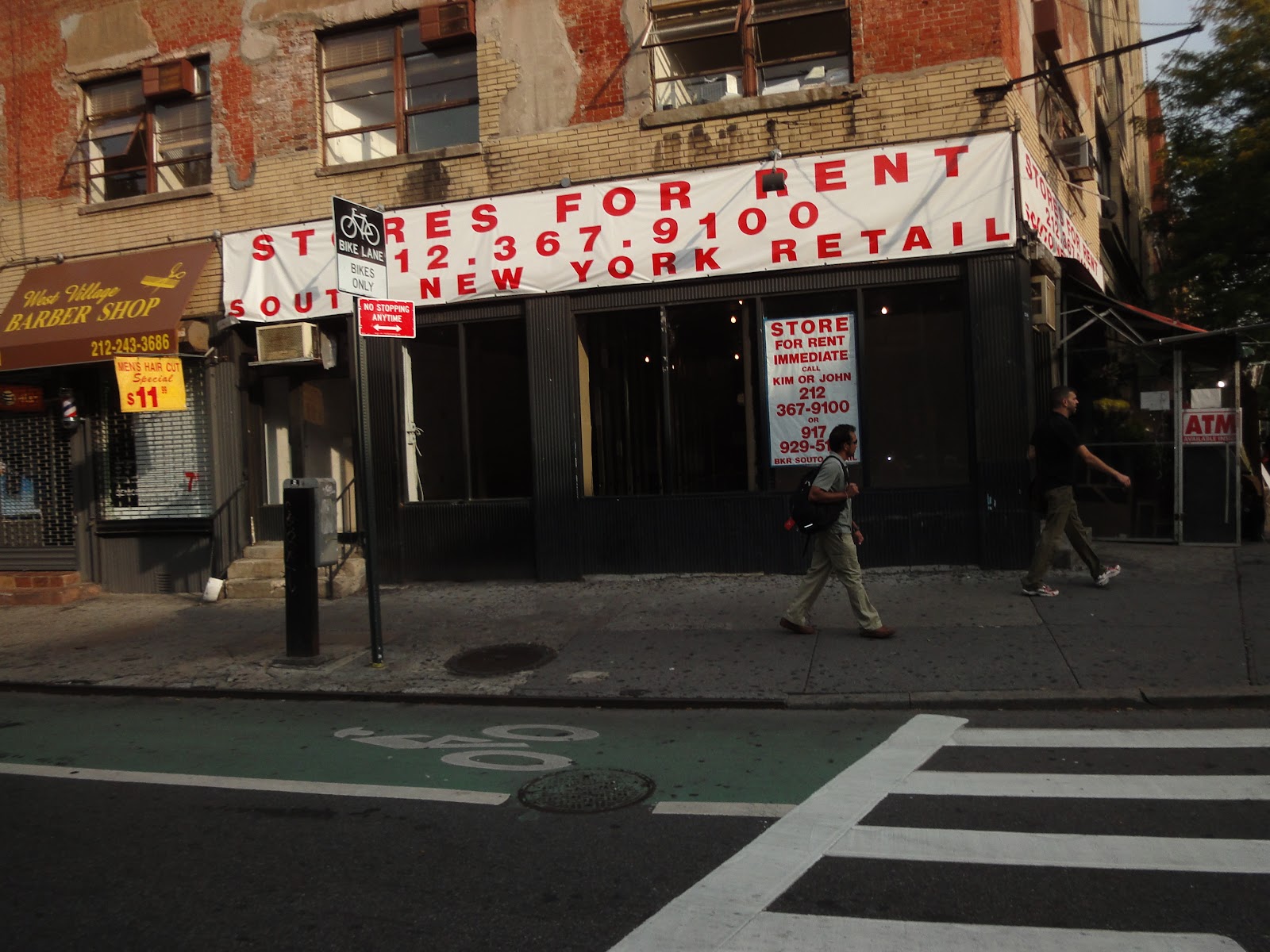
A friend of mine said he wants to open a wine bar and told me there were "tons" of vacant store fronts in my neighborhood.  I did not recall "tons" of space for rent so I paid attention when walking up Hudson St. in the West Village yesterday and was surprised to find just that.  These pictures were taken in the 6 block stretch between Barrow St and Bank St. I understand this is just a small sample, but I find it somewhat odd that "recovery" looks like. I would add that last week I had lunch with a friend who works in commercial real estate in New York and he was very optimistic and said everything was great in the city...I am no expert and I am sure he has much better information than me, but I found that these pictures tell a slightly different story.


Hudson St in Manhattan's West Village
 

Thursday, September 23, 2010

Asia to the USA: "We've got you by the b@lls!"

A friendly Asian tourist shows onlookers who's the boss near Wall St this afternoon 

Who is really in the position of power here:  Asia or the US?  There are a number of arguments one can make about which party has "hand" - to use a Seinfeldism.  Asian export economies have surely felt some pain as the American consumption engine has slowed.  At the same time Asian countries (namely China and Japan, but do not forget about Hong Kong, Taiwan, Thailand, and Singapore) hold over $2 trillion in US treasuries.  Based on the current strategy, that number is set to grow quite a bit over the next decade so we need to keep the tap running.  China is particularly important because as of July they were the biggest holder of our debt, with $850 billion in treasury bonds on the book.  As this position grows, China becomes increasingly concerned about the Administration's largess and its impact on the value of the dollar.  To make matters worse, Washington continues to whine to Chinese Premier Wen (1 point Laruso for alliteration!), pressuring him to do his part in accelerating the appreciation of the yuan so the US can gain a competitive advantage via exporting goods of its own.  (I will not even get into protectionism here but that is another variable that makes this game of chicken even more dangerous...some interesting thoughts on free trade by my buddy Ken Monahan - LINK).         

If the US wants to slay the dragon (if that is even possible) it has to get back to work and find ways to participate in the next bull market which will be driven by the emerging world. Some food for thought from a recent Huffington Post article: "Ninety-five percent of the world's consumers live outside of our national borders, but only one percent of American businesses sell to them. We're in a global race with China, Japan and Korea to enter and corner key markets of fast-rising Asian economies. If we want to grow our economy, we need to go where the growth is. One billion people will join the global middle class in the coming decade. That's a billion worldwide consumers buying cars, traveling on planes, consuming electricity and purchasing better medical care. That's one billion new opportunities for American businesses." (LINK)  I tend to agree......

Tuesday, September 21, 2010

America the Naïve

Sep 21st NY Post Cover (LINK)
The cover of this morning's NY Post pretty much sums it up for me.  A distressed Obama supporter, Velma Hart, is losing faith.  She said to the President in a town hall meeting: "I'm exhausted of defending you, defending your administration, defending the mantle of change that I voted for, and deeply disappointed with where we are right now.  I have two children in private school. The financial recession has taken an enormous toll on my family.  My husband and I have joked for years that we thought we were well beyond the hot dogs-and-beans era of our lives. But, quite frankly, it is starting to knock on our door and ring true that that might be where we are headed again.  Quite frankly, Mr. President, I need you to answer this honestly: Is this my new reality?"

Short answer:  YES.  I am confused about what Mrs. Hart really thought would happen.  I will admit that I voted for Obama but my vote was calculated using the process of elimination and not about delusions of grandeur.  Did Americans like Mrs. Hart believe that by injecting Barack Obama into office would magically create new opportunity and wealth for America?  This is a dangerous kind of faith to have in a political leader and one that epitomizes the kind of entitlement state people have become accustomed to.  Obama vowed to bring change to the country and he did.  How people choose to interpret and rely on these changes for their personal lives is up to them.  However, I would err on the side of caution.  Depending too much on the institution (private or public) is exactly what got us into this mess.  

The United States of America needs a change of mindset.  This is not something one leader is capable of achieving overnight. First, what the middle class needs is a reality check.  It appears that there is a negative correlation between our economy and our expectations – as the financial condition of our country deteriorates the citizens of our nation come to expect more from politicians.  This is a dangerous proposition because it encourages the perpetual blame game.  The accountability of our actions gets pushed on some other party.  Is this really what we have become?  Blame everyone else for our problems and then expect our leaders to fix them?  

The United States of America needs to convert toward thinking less about what it is entitled to and more about what it can do to create value: whether that means halting the exploitation of the dollar, or becoming more competitive globally through technology and innovation, or catering to an emerging world that is experiencing significant growth and wealth creation.  My concern is that there is an entire middle class that may have incorrectly perceived Obama’s call of duty as one that would change lives overnight.  If this is a case then we should prepare for more public displays of disappointment like the one from Mrs. Hart.  Let’s just hope that everyone will be as peaceful as she was.